Stop experimenting with AI. Start putting it to work.
Posted: Monday 19 October 2026
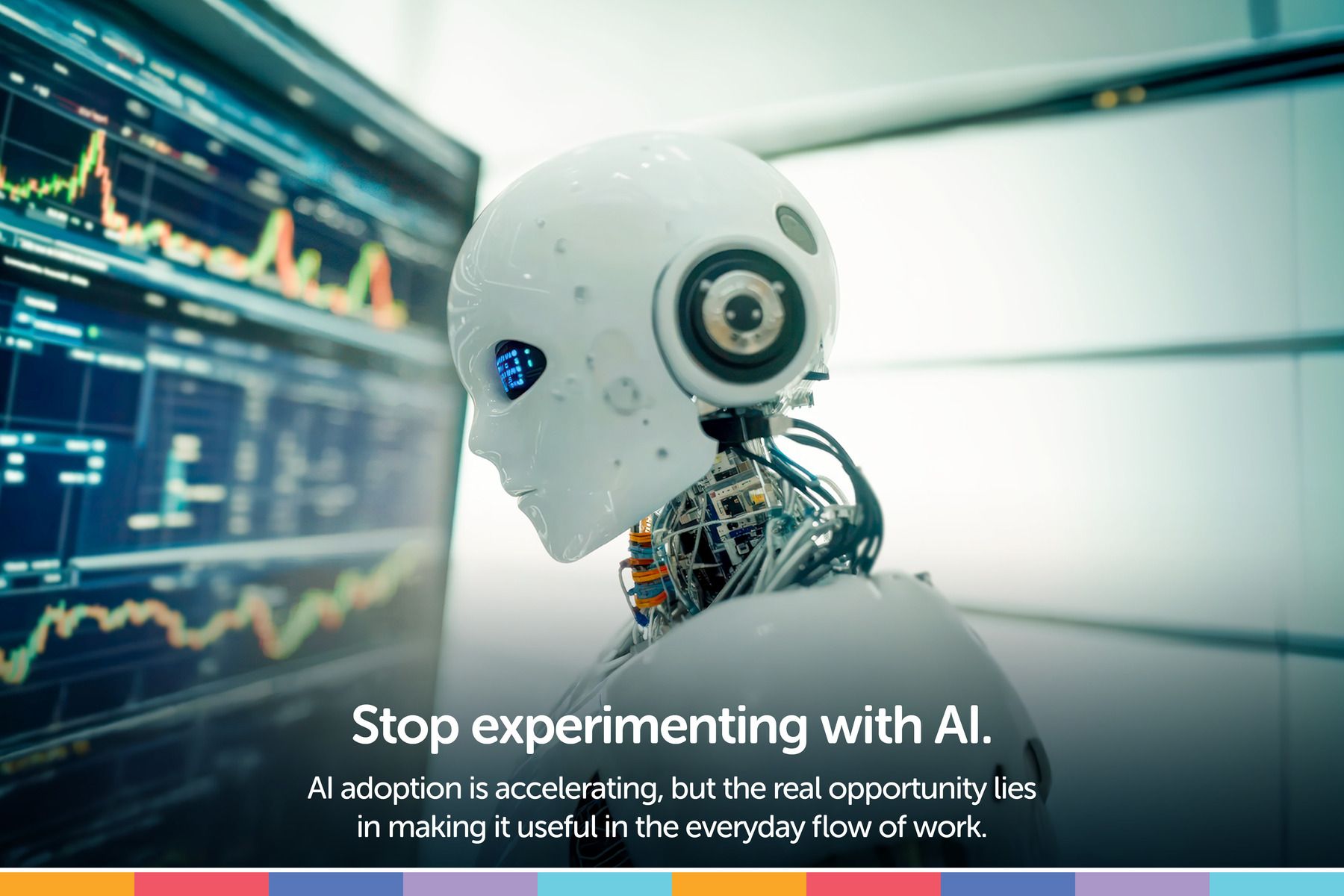
AI adoption is accelerating, but the real opportunity lies in moving beyond isolated experiments and making it useful in the everyday flow of work.
For the past couple of years, much of the conversation around AI has centred on possibility.
What can it do? Where could we use it? Which tools should we try?
Those questions have been important, but the conversation is beginning to change.
KPMG's latest Global AI Pulse shows organisations moving rapidly from experimentation towards wider adoption. The proportion it describes as being in the "driving adoption" stage rose from 13% to 22% in just one quarter, while 76% of senior leaders surveyed said AI was already delivering meaningful business value. Source
The question, increasingly, is no longer simply whether to use AI, but where does it actually make work better?
From interesting technology to useful technology
That distinction matters.
A successful AI strategy does not necessarily mean introducing AI everywhere. It means identifying the parts of a business where it can remove friction, save time, improve access to information or help people make better decisions.
KPMG makes a similar point. As adoption increases, organisations are shifting their attention away from individual use cases towards the wider capabilities needed to embed AI into the business. Its report describes the next challenge as redesigning work so that people and AI can operate effectively together.
For Trust and Corporate Service Providers, that brings the AI conversation much closer to everyday working life.
Where are skilled people still spending time on repetitive administration? Where does information have to be found, checked, summarised or transferred before someone can act on it? Which routine tasks are occupying time that could be spent on clients, oversight and higher-value work?
Those are often better starting points than asking where AI can be introduced simply because the technology exists.
Start with the work people actually want to lose
We saw something similar when we asked delegates at STEP Guernsey a simple question:
What task would you most like AI to take off your desk?
The answers were strikingly practical.
Emails came first, followed by timesheets, document management, onboarding and meeting notes.
Nobody was asking AI to run the business. They wanted it to take away some of the everyday workload surrounding their real jobs.
And that is perhaps where the next stage of AI adoption becomes particularly interesting.
AI can help people find and summarise information, prepare documentation, support onboarding and reviews, capture actions from meetings and deal with routine communication. Used in the right places, it can reduce the administrative layer around professional work rather than attempting to replace the expertise at its centre.
AI, automation or a person?
It is also worth remembering that not every problem needs AI.
Some tasks are predictable, rules-based and repetitive. Traditional automation may still be the most efficient way of handling them.
Other tasks involve language, interpretation, large amounts of information or changing circumstances. That is where generative or agentic AI can add something different.
And there will always be areas where professional judgement, experience and human interaction remain fundamental.
The opportunity is in combining these intelligently rather than treating AI as a replacement for everything that came before it.
Making AI part of the workflow
This is where we believe the market is heading next.
AI will become less visible as a standalone "tool" and increasingly become part of the systems and processes people already use.
Instead of asking someone to leave their normal workflow, open an AI application and give it instructions, useful AI will increasingly sit within the work itself, helping retrieve information, complete tasks, identify what requires attention and support the person responsible for making the decision.
KPMG's research suggests this transition is already underway. Seventy-one per cent of leaders surveyed said their organisations were making good progress towards a more integrated AI-human workforce.
For regulated financial services businesses, the potential is considerable.
But the objective should not be to deploy as much AI as possible.
It should be to find the points where AI and automation can make a measurable difference to the way people work, then build them into processes in a way that feels natural, useful and sustainable.
The experimentation phase has shown us what AI can do.
The next phase is deciding what we actually want it to do for us.